Thursday, 12 April 2012

Audience feedback


Here is the feedback we got about our film 'Blackmail' from fellow classmates, friends and others. Overall as a group we were pleased with what people had to say, and are definitely pleased with ourselves on how the film came out. We are also happy that people noticed the typical conventions of a film noir through out our own film noir. Especially things such as mise-en-scene, locations and camera angles.

Tuesday, 10 April 2012

Editing our Film Noir - Camera Angles/Techniques

Through out our film noir we experimented with many different techniques and various camera angles, trying to achieve something that would appear in a top quality film noir
Opening sequence of Blackmail has scrolling text across the screen.


Two-shot
Here we are presented with a two shot of when Clark and Nancy first meet at her movie premier


 Extreme close up
This is an extreme close up of Nancy's face as Clark is seen to be in a daze


Long shot
Clark is approaching Nancy's house


Over the shoulder shot
Clark is at Nancy's doorstep, surprising her with a visit


Low key lighting/two shot
Here we are presented with Clark telling Nancy he misses her. Also the typical convention of low key lighting is apparent here, and it also relates to the scene. As Clark is playing Nancy for money, the dark and gloomy atmosphere relates to the mood


 Close up
This close up shot shows Martha discovering Clark's plot against Nancy


Establishing shot
This establishing shot presents us with Nancy's house. Martha is seen following Clark to see what he's up to


 Point of view shot
The point of view shot, shows the draft that Martha has posted through Nancy's letter box. Nancy is seen reading this in shock


 High angle shot
The shot looks down on Nancy as she reads the draft, the shot also makes her feel intimidated by the letter


 Low angle shot
Nancy is seen going round to Martha and Clark's house, she is almost seen as a threat by this low angle shot


 Venetian blinds
These two screenshots show the two ladies talking, with venetian blinds apparent in the background. Venetian blinds are a key convention of a film noir, and I think this shot looks perfect and typical of a film noir


Many of these camera angles and techniques can be seen in film/neo noirs that I have watched. Here are a few films which show typical conventions which have been used in our film.


Here is a screenshot from 1944 film 'Double Indemnity'. This is a two shot with low key lighting, very similar to a shot in Blackmail which was previously shown up towards the top of this page


Here is an establishing shot from modern noir film 'Brick'. This shot was used to distinguish the villains house.

Here is another example of a technique used in 'Brick' which is apparent in our film noir. Low key lighting is used to give the film that dark and mysterious atmosphere



Editing our Film Noir - Music/Sound Effects

Another struggle along the way of making our film was the process of finding music and sounds. The sound was obviously a very important feature for our film noir, we needed sounds to make our film the best it can be. We used sounds to create tension, gun fire etc. In order to use certain sounds, we had to email certain websites.

Editing our Film Noir

Editing our Film Noir was probably the most technical and hardest part of the overall project. Once we had finished filming everything we began to edit using iMac computers. We uploaded all of our footage from the HD camera's onto the computer using the USB lead. Once they were onto the computer we transferred them all to 'Final cut express' (our editing program used). As a group we would discuss the editing and decide on how things were to be done, we would all come to agreement on something and apply it to our film.                                      
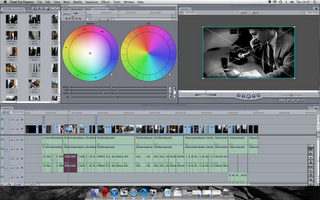
The whole idea of a typical film noir is that it's in black and white. To achieve this film noir convention we firstly clicked 'Effects' > 'Video Filters' > 'Colour Correction' > 'Colour Corrector'.
Once we reached the final step and clicked colour 'Colour Corrector' it opened up a new tab, which looked like the following image.  


Here is the next step of the editing process and achieving the black and white effect. The new tab will show two colour wheels, with slider options beneath both of these wheels which adjusts the saturation of the image. This was quite a simple process and all it involved doing was sliding the saturation bar to the end furthest left. As you can see in the image the film is now converted into black and white.


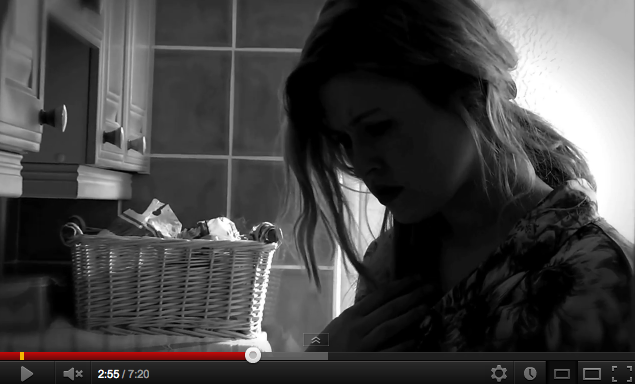
After converting the clips to black and white, we watched the footage that we had so far and came to the conclusion that everything was a bit too flat and compared to a typical film noir, it didn't really have that mysterious feel. So next we searched around in 'Effects' > 'Video Filters' > 'Stylize' and applied many different filters, and we chose to use 'Vignette'. Overall this gave the clip and footage a darker edge, and made it look mysterious and gloomy, just how a typical film noir should appear.
 Through out the editing process we had to cut a lot of clips down, as they were either too long or there was footage on them that wasn't needed. Especially as the film had to be around the five minute mark. So using the cut tool, which you can see on the far right of the screen, we would hover over the clip and click the part we didn't want and simply press delete.                                                                            

Final Film - Blackmail

Here is mine, Jessica Bonds and Beth Robson's Film noir, enjoy

Production Company

Every film has a production company, and for our film noir to look as professional as possible, we had the task of creating our own. Here are a few production company's that are featured in many films we see today.

Paramount Pictures
Paramount Pictures Corporation is an American film and television production and distribution company. Paramount was founded in 1912 and is the third oldest production company in the world.
Paramount have also produced a number of Film noirs, including 'Double Indemnity' which was one of the first film noirs that our class watched.

Metro-Goldwyn-Mayer Studios Inc      
MGM are an American media company, mainly involved in film production. They were founded in 1924 by Marcus Loew. MGM have also had their very own film noir collection, three of these films include :
  • A Woman's Face
  • Keeper of the Flame
  • Desire Me 


After researching many production company's and focusing on two, it was then our job as a group to come up with our very own production company. It did take a while to come up with an idea and a central image. After all chipping in ideas we came up with the very simple 'Stickman Productions'

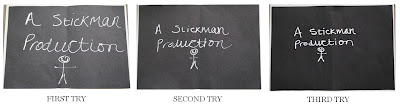
This was our first idea and as you can see it did look quite plain, boring and didn't stand out at all. So after talking about it and coming up with idea's we thought that it would be a good idea to write on a plain black piece of paper 'A Stickman Production' with a small little stickman underneath the text.


Here is the final outcome, and as you can see we had three attempts at it. In the end we recorded me writing it down and then finishing it off with a little stickman beneath the text

Props and Costumes

Props
After choosing our locations for Blackmail we moved on to look for props and costumes. We took into account that the film is set in the 1950's so we couldn't really have anything modern and get away with it. We chose pretty simple but yet effective props, including old teapots, drinks glasses (antique) photographs and text that looks old and gives a vintage feel and last of all an old telephone, which would have been used in the 1950's.
The teapot and breakfast set up was used in scene two when Clark is seen in the kitchen with his wife Martha. The teapot is also used when Martha reads Clark's draft and plan against Nancy in scene five. The vintage pouring glass is in Clark's office when Nancy walks in and is offered a drink by him. The next load of props were all placed at Clarks desk in his office. We used a 1950's telephone which can be seen in the image below the desk, but also Beth printed out photograph's which were used at Clark's draft notes. Lastly we had an old-school camera which was placed on his desk. This was borrowed from the photography department at the school, meanwhile all of the other props were borrowed from the school drama department.

Costumes
The suit I wore was quite plain and simple, yet very typical of something worn in the 1950's. I wore this with a trilby hat and a plain white shirt, everything fitted perfectly and was very comfortable. In certain scenes I wasn't seen to be wearing my jacket or hat, this is because of Clark's nature, which is quite layed back and relaxed. I also wore glasses, which stereo-typically made me seem more intelligent. This felt like a key feature to the outfit, as it contrasts from Clark's relaxed and layed back look on things to his intelligent and hard working side, which can be seen in various scenes through out the film.


Martha's personality as described was relaxed and quite reserved, so choosing the costumes for Martha was a challenge. The outfits are all quite similar and aren't too flamboyant or loud, this matches with her personality quite well as she is a typical housewife of the era. The black dress was the outfit used for the last scene, and it is quite different to all of her other outfits. Instead of using typical film noir colours of red and white, we chose black to add a sense of mystery to who the actual femme fatale is.


Nancy's outfits were a lot more loud and in your face, much like her personality. Each costume is different and this represents her glamorous lifestyle as a celebrity (being able to afford things) We also chose to use each outfit for a different scene, and the last scene features Nancy wearing a fur coat. Again there are no typical colours of a femme fatale (red/white) this is because we wanted to add a sense of mystery and surprise to the viewer when they watch the final scene.